
Three things to do before any clearance firm comes in
Most of the calls we get about a clearance come at a hard time: a parent has died or gone into care, a tenant has left a house full of things, or a move to somewhere smaller is a week away. Whatever the reason, the same three jobs done first make the day simple.
- Decide what stays, and mark it. Anything the family is keeping, anything a buyer has agreed to take, anything a relative is collecting later: put it in one room, or put a sticker on it, and tell us. On the day the crew checks the keep pile before a single thing goes on the van, and what is marked is not touched.
- Go through the drawers and the paperwork yourself. Our crews set aside anything that looks personal, which means papers, photographs and jewellery boxes, but nobody knows a house like the family does. If you think something is worth money, have it valued or sold before we come, because we do not buy contents and we do not knock the price down for them.
- Ask whoever you use for their waste carrier registration. Anyone who takes other people's waste for money must be registered, with the Environment Agency in England or Natural Resources Wales in Wales, and if the waste from your house is fly-tipped you can be fined as the householder. Ours is CBDU13412, held by Paul Duffield, and we send a copy to anyone who asks.
Step 1: the photos and the quote
Send us a photo of every room, the loft, the garage and any outbuildings, with the postcode and a line on what is staying. WhatsApp is easiest. From those we quote before the day, so there is no walking round the house with a clipboard and no surprise at the end.
The quote has two parts and no price list, because a single garage and a full farmhouse share nothing but the method. The first part is the crew's time, counted from leaving our base to getting back, so the drive to the tip is in it from the start. The second is a waste charge by weight for whatever cannot be rehomed, confirmed when the loaded van is weighed in. Access changes the time: a second-floor flat on a town-centre street, a cottage with no room to turn a van, or a farmhouse at the end of a long track all take longer than a bungalow with a drive, and the quote says so.
In Chester, tell us about parking. The terraced streets in Hoole and Handbridge sometimes need a bay suspension booked ahead; our parking and access guide explains how that works.
Step 2: keys, timing and who needs to be there
You do not have to be there. Many of the houses we clear in Powys belong to a parent whose family lives hours away, and we work with whoever holds the keys: the solicitor, the estate agent, a neighbour. You agree the quote from the photos, tell us the keep list, and we send word when the house is empty.
If you would rather be there, be there at the start. A walk round the house with the crew takes ten minutes and settles every question before the lifting begins. After that, most people go and do something else.
Step 3: the clearance day
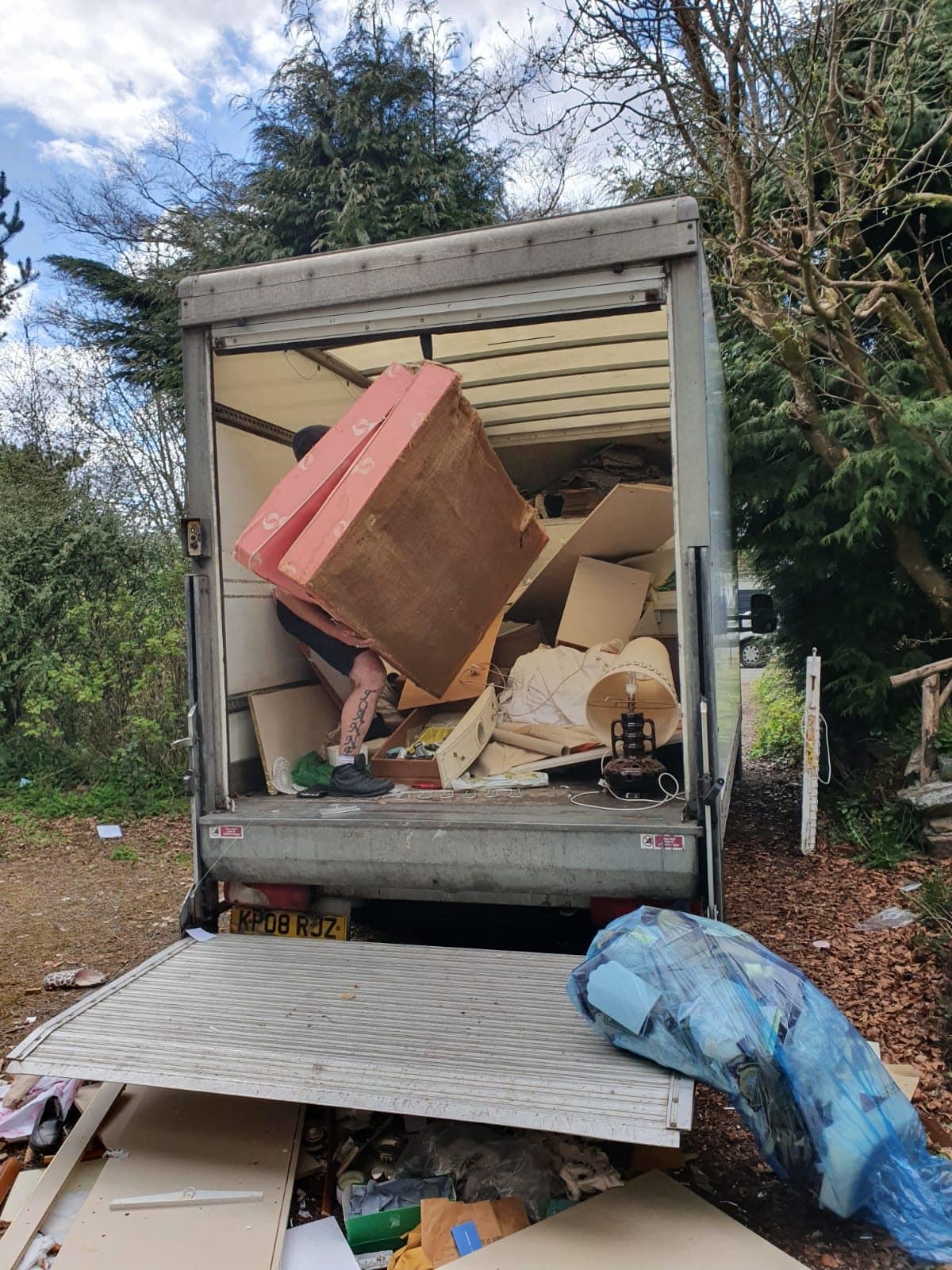
The crew arrives in our own Luton vans, the ones with "Removals, House Clearance & Waste Disposal" on the side, and starts with the keep pile. Once that is checked, the big furniture goes first: beds, mattresses, wardrobes, sofas, the dining table. Then the boxes, bags and the contents of cupboards, room by room. Loft, garage, shed and outbuildings are cleared last, because they usually hold the heaviest and dustiest part of the job.
Papers, photographs and anything that looks personal go into a box kept to one side for the family, never into the waste.
A clearance can be more than the house. In Mid Wales there is often a barn or a stable block that has been filling up for years; each building is cleared and priced the same way as a room, from photos, so you can clear the house now and the outbuildings later if that suits the sale.
Step 4: where everything goes
Nothing goes straight to the tip. Usable furniture and household goods go to local charities, or are rehomed, wherever someone will take them. Charities choose what they can sell, and upholstered furniture usually needs its fire safety label still attached, so not everything qualifies, but whatever they take never reaches the scales and that keeps your waste charge down.
What is left goes to a commercial recycling centre, where the van is weighed on the way in. That weight is the waste charge on your invoice, which is why we confirm it after the weigh-in rather than guess it beforehand.
If you want to give things to a charity yourself, do it before the clearance and we take the rest. Some charities collect good furniture for free, but they only take what they can sell, and they will not empty a house.
Step 5: the waste transfer note
Every waste job produces a waste transfer note, and we keep every one on file. Ask and you can have a copy for your records; executors and letting agents often do. It is the paper trail that shows the waste from the house went where it should, under a registered carrier, and it is worth asking any clearance firm whether they can produce one.
Clearing a home after a death
There is no right speed. Some families want the house empty in a week because a sale is agreed; others take months and clear a room at a time. Both are fine with us: we quote from the photos whenever you are ready, and the quote holds for the work described.
Two practical things before the clearance starts. If the estate has a solicitor, check with them that the contents can go, and leave in place anything a relative has questioned. And if the house is now empty, tell the insurer, because most policies change once nobody lives there.
When the family cannot decide about certain pieces, they can be set aside and moved later rather than cleared; ask whether our storage in Chester has room at the time.
A clearance and a move in the same week
When a downsize and a clearance fall together, we quote both as one job. The furniture you are keeping goes to the new home on one van, and what you are leaving behind is cleared on another, by a crew who know which pile is which. Our house clearance in Chester and house clearance in Powys and Mid Wales pages cover each area, and waste removal covers garages, lofts and office clear-outs.